Afro Hair Transplant in Islamabad: Complete Guide to Restoration, Costs & Recovery
Timeline, procedure & Expert Tips
Are you experiencing hair loss and searching for effective solutions specifically designed for Afro hair texture? Afro Hair Transplant is an increasingly popular surgical solution that restores natural hair growth while respecting the unique characteristics of curly, coiled hair.
This comprehensive guide explores what you need to know about hair restoration procedures in Islamabad, including costs, recovery timelines, and why choosing the right surgeon matters. Whether you’re considering FUE, DHI, or Sapphire FUE techniques, this pillar resource provides the expertise, real patient experiences, and actionable insights to help you make an informed decision about your hair restoration journey.
Introduction to Afro Hair Transplants: What You Need to Know
Hair loss affects millions of people worldwide, but the impact on individuals with Afro hair can be particularly challenging. Unlike other hair types, Afro hair has unique structural characteristics that require specialised surgical expertise. When performed correctly, Afro hair transplants deliver exceptional results that look completely natural while respecting the hair’s inherent curl pattern and density requirements.
Why Afro Hair Requires Specialized Techniques
Afro hair has a unique structure with natural curl patterns and specific density requirements that differ significantly from straight hair types. The follicles naturally curve as they grow, requiring extraction angles of 30-45 degrees rather than the straight 90-degree extraction used for Caucasian hair. This fundamental difference means traditional hair transplant methods developed for European hair patterns often fail with textured hair because they don’t account for several critical factors:
- Hair growth trajectory: The curved follicle angle must be preserved during extraction to maintain viability and ensure natural growth direction after transplantation.
- Density requirements: Afro hair appears less dense due to its curly nature, so higher graft numbers are needed (3000-5000+) to achieve visible density compared to straight hair.
- Follicle extraction challenges: Curved follicles are more fragile and require specialised extraction tools and techniques to minimise trauma and maximise graft survival rates.
- Recipient site creation: Placing grafts at incorrect angles results in hair growing sideways or lying flat rather than standing upright with natural curl definition.
Understanding Hair Loss in Afro Hair
Hair loss in individuals with Afro hair can result from multiple causes, each requiring different treatment approaches and varying transplant strategies. The most common causes include:
- Androgenetic alopecia (genetic hair loss): The most common type, affecting DHT-sensitive follicles. Men experience male pattern baldness while women suffer female pattern baldness, both showing progressive hair thinning and recession.
- Traction alopecia: Permanent hair loss from chronic tension applied to hair roots through tight braiding, weaves, or protective styling. This represents 1-3% of alopecia cases but is particularly common in Afro hair communities.
- Traumatic alopecia: Hair loss from burns, scars, chemical damage, or surgical procedures. It can affect specific regions requiring targeted transplantation.
- Telogen effluvium: Temporary shedding triggered by stress, illness, or nutritional deficiencies. Usually reversible, but can become chronic
Expert Insight: According to hair loss research, individuals with Afro hair experience different patterns of androgenetic alopecia compared to other populations, often with faster progression and earlier onset. This makes early consultation with specialists critical.
Why Afro Hair Transplants Offer Permanent Solutions
Unlike topical treatments (minoxidil), oral medications (finasteride), or non-surgical therapies that require ongoing use indefinitely, hair transplants provide permanent, lifetime hair restoration. Transplanted hairs retain their genetic characteristics from the donor area and continue growing naturally throughout your lifetime, making this a true one-time investment in your appearance and confidence.
The average transplanted hair grows for 15+ years, and many patients report continued growth beyond 20 years post-transplant. This permanence, combined with the psychological boost of restored confidence and improved self-image, makes hair transplants the gold standard treatment for permanent hair loss.
Types of Afro Hair Transplant Procedures: Comprehensive Comparison
FUE (Follicular Unit Extraction)
In FUE (Follicular Unit Extraction), Individual hair follicles are extracted one by one from the donor area using motorised or manual punches (0.6-1.0mm diameter). Each extracted follicle is carefully placed into the recipient area.
- Minimal scarring (nearly invisible)
- Individual follicle extraction
- Natural-looking results
- Quick recovery time
- No linear scar.
Best for: Individuals who prefer short hairstyles
DHI (Direct Hair Implantation)
DHI (Direct Hair Implantation) is an Advanced technique using implantation pens to place grafts directly without creating recipient sites first. The Choi implanter determines angle and depth automatically.
- Highest precision placement
- Best for curly hair angles
- No intermediate storage time
- Optimal graft survival rates
- Maximum naturalness
Best for: Premium results with specialised curves
Sapphire FUE
Enhanced FUE using sapphire blades instead of steel for creating recipient channels. Sapphire is harder and smoother, creating more precise channels.
- Advanced channel creation
- Smoother recipient sites
- Reduced tissue trauma
- Ideal for dense grafts
- Faster healing
Best for: Maximum density in limited areas
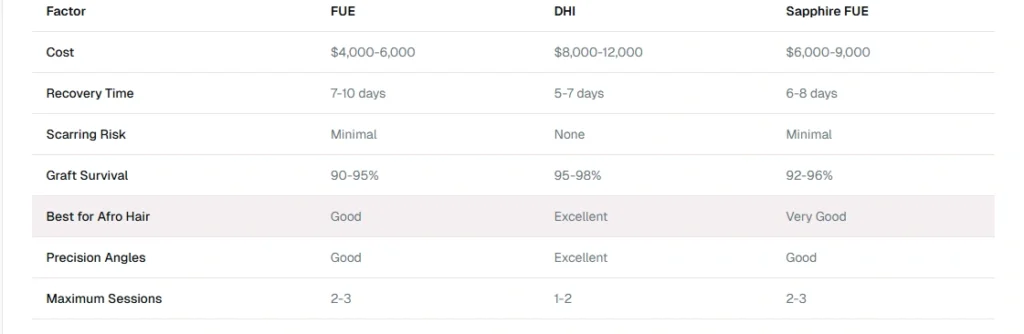
Detailed Comparison: Which Method is Best for Your Afro Hair?
Recommendation for Afro Hair
For most Afro hair patients, DHI (Direct Hair Implantation) represents the gold standard when budget allows, due to its superior angle precision and lack of scarring. However, Sapphire FUE offers excellent value as a middle ground between cost and results. Standard FUE works well for those seeking a cost-effective solution, though it requires more surgeon expertise to achieve natural angles with textured hair.
During your consultation, our specialists will recommend the optimal technique based on your hair characteristics, donor availability, budget, and aesthetic goals. Many patients benefit from combining techniques—for example, DHI for hairline precision and Sapphire FUE for density.
The Afro Hair Transplant Procedure: Detailed Step-by-Step Process
Understanding what to expect during your hair transplant procedure helps reduce anxiety and ensures you’re mentally prepared. The process is meticulous, requiring precise coordination between your surgeon and the surgical team.

Pre-Operative Consultation & Assessment
Your specialist conducts a comprehensive evaluation of your hair loss pattern, evaluates hair density in both donor and recipient areas, and designs your personalised hairline and restoration plan. Advanced imaging technology helps visualise potential results.
Duration: 2-3 hours
Key Details:
- Hair density analysis in grafts per square centimetre
- Assessment of donor area quality and quantity
- Hairline design customised to your facial features and age
- Discussion of expectations and realistic outcomes
- Medical history review and health screening
- Photography for before comparisons
Donor Hair Extraction (most critical for Afro hair)
Individual follicles are carefully extracted from the donor area (typically back and sides of scalp) using motorized punches at precise 30-45 degree angles to match the natural curl trajectory of Afro hair. This requires specialised expertise.
Duration: 2-4 hours
Key Details:
Local anaesthesia was applied to the donor area
Motorised or manual punches extract individual follicular units
- Each follicle is extracted at an optimal angle for Afro hair
- Grafts are immediately placed in preservation solution
- Careful attention to minimise follicle damage
- Continuous monitoring of graft quality


Graft Preparation & Sorting
Extracted grafts are sorted under sterile conditions, separated into single, double, triple, and four-hair grafts. Each graft is examined for viability, and non-viable grafts are removed.
Duration: 1-2 hours
Key Details:
Microscopic examination of each graft
Separation into optimal combinations for hairline vs. density
- Removal of non-viable or damaged grafts
- Organisation of grafts by location for transplantation
- Placement in specialised preservation solutions
- Temperature and humidity control throughout
Recipient Site Creation (precision essential for Afro hair)
Recipient sites are created in the balding areas at precise angles. For Afro hair, angles of 30-45 degrees and specific depth are critical for natural-looking results where hair grows upright with curls visible.
Duration: 1-2 hours
Key Details:
Local anaesthesia is applied to the recipient area
Sites created at 30-45 degree angles (critical for Afro hair)
- Careful depth control to match natural hair emergence
- Strategic spacing to achieve natural density
- Consideration of existing hair in balding areas
- Attention to hairline aesthetics and natural appearance


Graft Implantation
Prepared grafts are carefully implanted into recipient sites. For Afro hair, single hairs are placed at the hairline and multi-hair grafts toward the crown for a natural-looking density.
Duration: 2-3 hours
Key Details:
Single-hair grafts placed at hairline edges
- Double/triple grafts for mid-scalp density
- Careful handling to ensure graft integrity
- Attention to achieving a natural-looking result
- Monitoring of blood flow and graft placement
- Final positioning verification
Complete Procedure Timeline
Most comprehensive Afro hair transplants take 8-10 hours total, conducted under local anaesthesia with mild sedation for comfort. You remain conscious throughout and can communicate with the surgical team. The procedure is broken into segments to rest and refresh. Pain is minimal due to anaesthesia, though you may feel gentle pressure and hear the sound of extraction tools. Most patients tolerate the procedure remarkably well and report minimal discomfort during the surgery.
Afro Hair Transplant Cost in Pakistan & Islamabad: Complete Breakdown
Understanding the factors that influence pricing helps you make an informed investment decision. Hair transplant costs vary significantly based on multiple factors, and transparency is crucial for building trust with your provider.
Factors Influencing Hair Transplant Cost
Number of Grafts Needed
Typically 2000-5000+ for Afro hair. More grafts = higher cost. Quoted per graft ($2-4 per graft typical).
Clinic Location & Reputation
Premium clinics with state-of-the-art facilities command higher fees. Islamabad offers excellent value vs international options.
Surgeon Experience & Expertise
Board-certified specialists with Afro hair focus cost more than generalists. Experience directly correlates with results.
Technology & Technique
Sapphire FUE ($3 per graft) costs more than standard FUE ($2.50). DHI adds $1-2 per graft premium.
Facility Amenities & Support
Premium facilities offer private recovery rooms, meals, and concierge services, reflected in pricing.
Cost Range in Islamabad
Budget-Friendly
2,500 - 4,500 USD
1500-2500 grafts, experienced surgeon, standard FUE
Good for localised restoration
Mid-Range (Recommended)
5,000 - 8,000 USD
2500-4000 grafts, specialist surgeon, Sapphire FUE
Best value-to-results ratio
Premium
9,000 - 15,000 USD
4000+ grafts, top specialist, DHI or advanced tech
Comprehensive restoration
International Comparison
12,000 - 25,000 USD
Turkey/US similar procedures
Islamabad offers 40-50% savings
Why Islamabad Offers Superior Value Without Compromising Quality
Competitive Advantages:
- Experienced surgeons trained internationally
- State-of-the-art facilities meeting global standards
- Lower operational costs are passed to patients
- No international markup or travel costs
- Convenient for regional patients
- Transparent local pricing
Cost Comparison (per graft):
Islamabad: $2.00-3.50 per graft
Turkey: $3.00-4.50 per graft
Dubai: $4.00-6.00 per graft
USA: $8.00-15.00 per graft
UK: $6.00-12.00 per graft
Savings in Islamabad: 40-70%
Investment in Your Future: Long-Term Value
While hair transplant costs may seem significant upfront, consider the long-term value proposition. A $5,000-8,000 investment provides permanent hair restoration lasting 15-20+ years without ongoing medication costs or maintenance treatments required by non-surgical options.
vs. Medications
Minoxidil & finasteride cost $100-200/month indefinitely. Hair transplant breaks even in 3-5 years with permanent results.
vs. Hair Systems
Hairpieces cost $500-2000+ per replacement every 4-6 months. Transplant provides natural hair immediately.
vs. Ongoing Treatments
Laser therapy, PRP, and other treatments average $300-500/session. Transplants provide one-time solution.
Afro Hair Transplant Recovery: Detailed Timeline & Essential Precautions
Understanding the recovery process helps you prepare mentally and physically for optimal healing. Recovery is typically faster than patients expect, with most returning to normal activities within 2-4 weeks.
Days 1-3: Immediate Post-Op
What You Can Do:
- Light swelling and redness are completely normal
- Sleep elevated on 2-3 pillows to reduce swelling
- Take prescribed pain medication as needed (usually mild discomfort)
- Avoid touching, scratching, or disturbing grafts
- Do NOT wash hair for the first 3 days
- Keep your head dry and protected from water
Important Restrictions:
Water, sweat, touching grafts, strenuous activity, alcohol, smoking
Pro Tips:
Wear loose, comfortable clothing. Bandages may be present; keep them in place as instructed.
Days 4-7: Early Healing
What You Can Do:
- First gentle hair wash using prescribed shampoo (surgeon will demonstrate)
- Continued use of pain medication if needed
- Light activities only (walking, reading)
- Continue sleeping elevated
- Scabbing begins as a normal part of healing
- Itching may develop. DO NOT scratch
Important Restrictions:
Hot showers, tight hats, sweating, exercise, and sexual activity
Pro Tips:
Use the prescribed gentle shampoo and follow exact washing instructions. Let water run gently over scalp rather than direct pressure.
Weeks 2-4: Progressive Healing
What You Can Do:
- Return to light office work is possible
- Short leisurely walks encouraged (very light exercise)
- Continue gentle hair washing with the prescribed shampoo
- Light massage of the donor area may begin (check with the surgeon)
- Scabs may fall off naturally (DO NOT force them)
- Hair shedding from traumatised non-transplanted hair is normal
Important Restrictions:
Gym, swimming, heavy lifting, tight hats, direct sun exposure, harsh hair products
Pro Tips:
If you experience unusual pain or signs of infection (increased swelling, pus, fever), contact your surgeon immediately.
Months 1-3: Shedding Phase (Shock Loss)
What You Can Do:
- Transplanted hairs may appear to fall out. This is NORMAL
- Roots remain intact even as hairs shed
- Some non-transplanted hairs also shed from trauma
- Gradual return to normal exercise routine
- Resume hairstyling with gentle methods
- Continue protective hair care
Important Restrictions:
Stress and worry about temporary shedding, harsh treatments, tight braids
Pro Tips:
Shedding phase typically lasts 6-8 weeks. Don’t panic—new hair will regrow from dormant roots. Monthly follow-ups track progress.
Months 3-6: New Growth Begins
What You Can Do:
- First fine hairs begin sprouting from grafts (fine and short initially)
- Hair gradually thickens and lengthens
- Complete return to all normal activities
- Style your hair however you prefer
- Enjoy your new permanent hair
- Schedule 3-month and 6-month assessments
Important Restrictions:
Excessive heat styling, harsh chemical treatments, stress
Pro Tips:
New growth is delicate initially. Continue protecting scalp during recovery. Results become visually apparent around month 4-5.
Months 6-12: Full Results Realization
What You Can Do:
- Substantial density improvement is visible
- Hair continues maturation and thickening
- Complete return to all normal activities
- Style your hair however you prefer
- Enjoy your new permanent hair
- Final assessment at 12 months
Important Restrictions:
Negligence in maintenance hair care
Pro Tips:
By month 12, results are essentially permanent. Hair will continue growing naturally throughout your life. Final density and coverage stabilize around month 12-18.
Preparing for Your Afro Hair Transplant: Comprehensive Pre-Surgery Guide
Pre-Surgery Consultation Checklist
- Comprehensive medical history discussion
- Current medications review and adjustments
- Allergies and adverse reactions identification
- Realistic hair restoration goal setting
- Before photos in standardised lighting
- Hairline design and recipient area discussion
- Transparent cost discussion and quote
- Recovery timeline and time-off work planning
- Insurance coverage verification (if applicable)
- Questions answered about procedure and recovery
Lifestyle Adjustments (Before Surgery)
- Smoking: Quit 2-4 weeks before surgery and 2-4 weeks after. Nicotine reduces blood flow to grafts
- Alcohol: Stop 1 week before and 1 week after surgery.Increases bleeding and interferes with medications
- Blood Thinners: Discontinue 5-7 days before (check with doctor).Increases surgical bleeding risk
- Vitamins: Stop Vitamin E, fish oil, and aspirin 5-7 days before. These thin the blood and increase bleeding
- Sleep: Get adequate sleep every night leading up to surgery. Good sleep supports immune function for healing
Medical Tests and Pre-Operative Clearance
Typical Tests Required:
- Complete blood count (CBC)
- Blood chemistry panel
- Coagulation tests (PT/INR)
- Blood pressure check
- Optional: COVID-19 test if required
Contraindications (Cannot Proceed):
- Uncontrolled high blood pressure
- Active scalp infections
- Untreated bleeding disorders
- Immunodeficiency conditions
- Significant liver or kidney disease
- Recent steroid treatments
Potential Risks and Complications: What You Should Know
Common Side Effects (Usually Temporary)
Temporary swelling
When: Days 2-5 post-op
Duration: Resolves within 1-2 weeks
Status: Normal, not dangerous


Common Side Effects (Usually Temporary)
Bruising around the eyes/forehead
When: Days 2-3 post-op
Duration: Fades in 1-2 weeks
Status: Normal, cosmetic only
Common Side Effects (Usually Temporary)
Itching at the recipient/donor sites
When: Weeks 1-4
Duration: Temporary, resolves
Status: Avoid scratching

Common Side Effects (Usually Temporary)
Temporary numbness
When: Common after surgery
Duration: Usually resolves within 3-6 months
Status: Rarely permanent
Rare Complications (Require Medical Attention)
Infection at surgical sites
- Symptoms: Increasing pain, pus, fever >101°F
- Treatment: Antibiotics, may need drainage
- Prevention: Maintain hygiene, keep the area clean
Excessive bleeding
- Symptoms: Bleeding that doesn’t stop with pressure
- Treatment: Medical intervention required
- Prevention: Avoid blood thinners, follow instructions
Cyst formation
- Symptoms: Small white bumps at graft sites
- Treatment: Usually resolve on own; rarely need removal
- Prevention: Proper graft handling by surgeon
Poor graft survival
Symptoms: Minimal or no hair growth at 12 months
Treatment: Revision procedure possible
Prevention: Experienced surgeon, proper post-op care
Unnatural appearance
Symptoms: Hairline doesn’t match expectations
Treatment: Revision procedures available
Prevention: Clear pre-op communication about design
When to Contact Your Surgeon Immediately
Warning Signs:
- Fever above 101.5°F
- Pus or discharge from incisions
- Rapid or excessive bleeding
- Severe pain unrelieved by medication
- Signs of allergic reaction (hives, difficulty breathing)
- Separation of incision edges
- Sudden severe headache

Why Choose an Afro Hair Specialist for Your Transplant
- Expertise Requirements for Specialists
- Formal, specialised training in textured hair transplantation from recognised institutions
- 1000+ Afro hair procedures personally performed
- Board certification from ISHRS and ABHRS or an equivalent surgical organisation
- Continuing education in the latest Afro hair techniques (annual minimum)
- Deep understanding of the unique anatomical considerations of Afro hair
- Portfolio of before/after photos demonstrating consistent natural results
- Patient testimonials specifically from Afro hair clients
Medical Disclaimer: This guide is educational and should not replace advice from your hair transplant surgeon or dermatologist. Always follow your surgeon’s specific post-operative instructions, as they may differ from general guidelines. If you experience signs of infection, excessive pain, or other concerning symptoms, contact your healthcare provider immediately