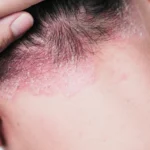
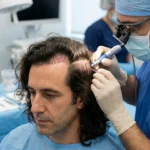
The difference between androgenetic alopecia and alopecia areata lies primarily in their underlying causes, pattern of hair loss, and treatment approach. Androgenetic alopecia is a genetic and hormone-related condition driven by DHT sensitivity, resulting in gradual hair thinning seen in male pattern baldness and female pattern hair loss. Alopecia areata, on the other hand, is an autoimmune disorder that causes sudden, patchy hair loss and may show spontaneous regrowth. Understanding how androgenetic alopecia and alopecia areata differ is essential for accurate diagnosis, appropriate treatment selection, and long-term hair management.
Introduction
Hair loss is not a one-size-fits-all condition, yet many people struggle to understand why treatments that work for one person fail for another. This confusion often arises when comparing Androgenetic Alopecia vs Alopecia Areata, two of the most common yet fundamentally different causes of hair loss. Although both conditions affect the scalp and hair follicles, their origin, progression, and response to treatment vary significantly.
If you are researching Androgenetic Alopecia vs Alopecia Areata, you are likely trying to determine which type of hair loss you are experiencing, whether it is reversible, and what treatment options are medically effective. In simple terms, androgenetic alopecia is progressive genetic hair loss, while alopecia areata is an autoimmune condition with unpredictable regrowth potential. This article explains these differences clearly, early in the discussion, so readers can make informed decisions without unnecessary delay.
Understanding Androgenetic Alopecia
Androgenetic alopecia is the most common form of genetic hair loss worldwide. It occurs due to inherited sensitivity of hair follicles to androgens, particularly dihydrotestosterone (DHT). Over time, this hormonal sensitivity leads to hair follicle miniaturization, causing strands to become thinner, shorter, and eventually unable to produce visible hair.
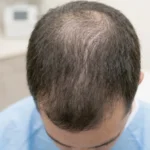
In men, androgenetic alopecia typically presents as a receding hairline and crown thinning, commonly known as male pattern baldness. In women, the condition manifests as diffuse thinning over the crown with preservation of the frontal hairline, referred to as female pattern hair loss. Contrary to popular belief, androgenetic alopecia does affect women, and early intervention plays a crucial role in slowing its progression.
What Causes Androgenetic Alopecia?
The primary drivers of androgenetic alopecia include genetic predisposition, androgen sensitivity, and hormonal influence. DHT-related hair loss is central to this condition, as DHT binds to susceptible follicles and shortens the hair growth cycle. Over successive cycles, hair density reduces gradually rather than suddenly, which is why many individuals do not notice the condition until visible thinning occurs.
Understanding Alopecia Areata
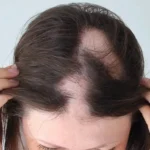
Alopecia areata is a non-scarring autoimmune hair loss disorder in which the immune system mistakenly targets healthy hair follicles. This immune attack disrupts the hair growth cycle, leading to sudden hair loss, often in the form of round or oval patches.
Unlike androgenetic alopecia, alopecia areata can affect individuals of all ages, including children. The condition may remain localized or progress to more extensive forms such as alopecia totalis or alopecia universalis. One distinguishing feature of alopecia areata is that hair follicles remain structurally intact, which explains why alopecia areata regrowth signs are commonly observed, even without treatment in some cases.
Alopecia Areata Symptoms and Clinical Features
Patients with alopecia areata often notice abrupt hair loss with smooth, hairless patches on the scalp or other body areas. Nail pitting, exclamation-mark hairs, and episodes triggered by stress or illness may also be present. The course of the disease is unpredictable, with periods of remission and relapse being common.
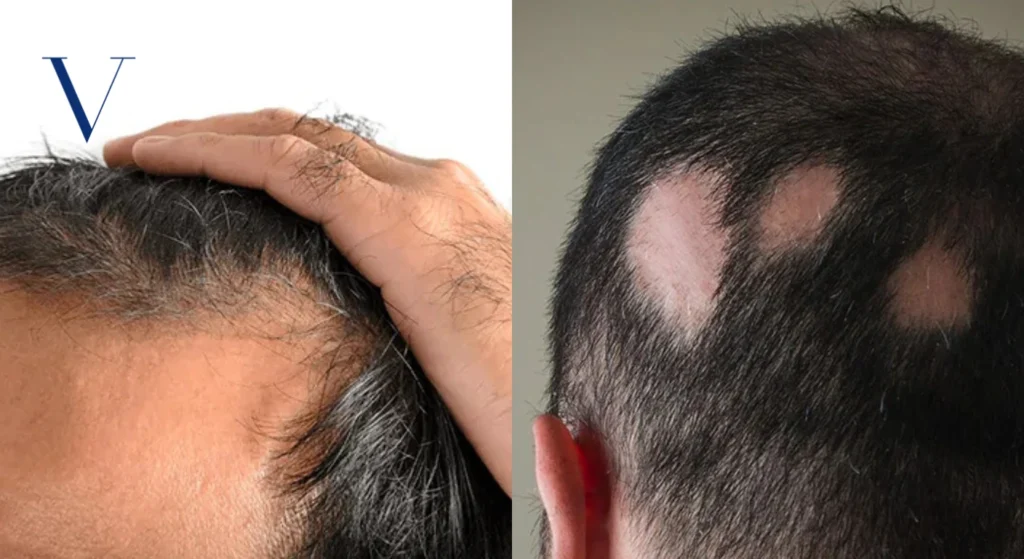
Androgenetic Alopecia vs Alopecia Areata: Key Differences Explained
When comparing androgenetic alopecia vs alopecia areata, the most important distinction lies in the mechanism of hair loss. Androgenetic alopecia is driven by genetics and hormones and progresses slowly over years. Alopecia areata, in contrast, is immune-mediated, often appears suddenly, and may show partial or complete regrowth.
Another significant difference is treatment response. Androgenetic alopecia requires long-term maintenance therapy, while alopecia areata treatment focuses on controlling immune activity and inflammation.
| Feature | Androgenetic Alopecia | Alopecia Areata |
| Cause | Genetics + hormones (DHT) | Autoimmune |
| Onset | Gradual | Sudden |
| Pattern | Predictable thinning | Patchy hair loss |
| Follicle damage | Progressive miniaturization | Follicles intact |
| Reversibility | Limited | Often reversible |
| Hair transplant | Effective | Not recommended |
Genetic Hair Loss vs Autoimmune Hair Loss
This comparison highlights why treatments are not interchangeable. In genetic hair loss, follicles shrink progressively but remain active for years, making medical and surgical interventions effective when started early. In autoimmune hair loss, follicles are temporarily suppressed rather than destroyed, allowing for regrowth once immune activity is controlled.
How to Tell Androgenetic Alopecia From Alopecia Areata
Clinical pattern plays a major role in diagnosis. Gradual thinning with a predictable distribution suggests androgenetic alopecia, while sudden patchy loss strongly indicates alopecia areata. Dermatologists may use dermoscopy, blood investigations, or, rarely, scalp biopsy to confirm the diagnosis and rule out conditions such as telogen effluvium or tinea capitis.
Treatment Approach: A Clear Difference
Treatment for Androgenetic Alopecia
Management focuses on slowing progression and improving hair density. Evidence-based options include minoxidil, finasteride (for men), anti-androgen therapy for women, platelet-rich plasma (PRP), and microneedling. Consistency is critical, as discontinuation often leads to renewed hair loss.
Alopecia Areata Treatment Options
Alopecia areata treatment aims to suppress immune-mediated inflammation. Corticosteroids remain a first-line therapy, delivered topically or via injections. Recent advancements include JAK inhibitors such as ritlecitinib (Litfulo), approved by the FDA in 2023, and other agents like upadacitinib (Rinvoq). Treatment choice depends on disease severity and patient profile.
Clinical Integration of Hair Transplantation with Minoxidil, Finasteride, and Dutasteride in Androgenetic Alopecia
Hair transplantation in patients with androgenetic alopecia is most effective when integrated with pharmacological therapy, as surgical redistribution of hair follicles does not modify the underlying pathophysiology of the disease. Androgenetic alopecia is driven by progressive follicular miniaturization mediated by dihydrotestosterone (DHT), which continues to affect non-transplanted native hair even after successful graft placement.
Minoxidil has been shown to prolong the anagen phase of the hair cycle and increase hair shaft diameter, thereby enhancing hair density and promoting post-transplant growth. Finasteride and dutasteride act as 5-alpha-reductase inhibitors, significantly reducing scalp and serum DHT levels, which is associated with stabilization of hair loss and preservation of existing follicles. Clinical studies consistently demonstrate that combination therapy using hair transplantation alongside long-term medical treatment results in improved graft survival, enhanced cosmetic outcomes, and reduced progression of surrounding hair loss when compared to surgical intervention alone.
Related, Oral Minoxidil vs Oral Finasteride for Hair Loss: Which One Improves Hair Shaft Thickness Better?
Consequently, current clinical guidelines and expert consensus recommend the continued use of medical therapy before and after hair transplantation to optimize long-term outcomes in androgenetic alopecia.
Hair Transplant for Androgenetic Alopecia: Clinical Insights from Vagus Hair Transplant
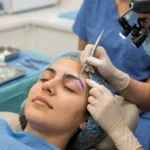
Hair transplantation is a well-established option for stable androgenetic alopecia when medical therapy alone is insufficient. Advanced techniques focus on relocating DHT-resistant follicles from the donor area to thinning regions such as the hairline or crown. Clinics such as Vagus Hair Transplant emphasize that transplantation is not a standalone cure but part of a comprehensive hair loss management plan. Proper candidate selection, control of ongoing hair loss, and realistic expectations are essential for achieving natural and sustainable results. It is important to note that hair transplant is not recommended for active alopecia areata, as the autoimmune process can affect transplanted follicles.
Can Alopecia Areata Regrow Hair Naturally?
Yes, spontaneous regrowth is possible, particularly in mild or early-stage cases. Stress management, anti-inflammatory lifestyle measures, and medical supervision improve outcomes, though natural remedies should be considered supportive rather than curative.
Can Alopecia Areata Turn Into Androgenetic Alopecia?
These are separate conditions and one does not transform into the other. However, it is possible for an individual to experience both conditions independently.
Which Condition Is More Common?
Androgenetic alopecia is by far the most prevalent form of hair loss globally. Alopecia areata is less common but remains one of the leading causes of sudden hair loss.
Final Thoughts
Understanding Androgenetic Alopecia vs Alopecia Areata is critical because each condition follows a distinct biological pathway and requires a different treatment strategy. While androgenetic alopecia is a chronic, genetically driven condition requiring ongoing management, alopecia areata is an autoimmune disorder with variable outcomes and potential for regrowth. Accurate diagnosis, early intervention, and medically guided treatment remain the foundation of effective hair loss care.
Frequently Asked Questions
How do dermatologists diagnose androgenetic alopecia vs alopecia areata?
Diagnosis is based on clinical examination, dermoscopy, and patient history.
Is there a permanent cure for alopecia areata?
Currently, no permanent cure exists, but long-term remission is achievable.
Does androgenetic alopecia ever reverse naturally?
No, but early and continuous treatment can significantly slow its progression.