Crown Hair Transplant in Islamabad: Complete Guide to Vertex Area Restoration
Expert crown baldness hair transplant solutions at Vagus Hair Transplant in Islamabad. Restore your crown area with advanced FUE techniques and achieve natural-looking results.
Crown hair transplant in Islamabad at Vagus Hair Transplant focuses on treating thinning or bald spots at the crown using advanced FUE techniques. The procedure involves the precise extraction and placement of healthy hair follicles to improve coverage and density in this sensitive area. Performed by skilled specialists, each treatment is carefully planned according to individual hair loss patterns, ensuring a safe procedure, minimal downtime, and long-term improvement in crown hair appearance.
Understanding Crown Baldness: The Vertex Area Challenge
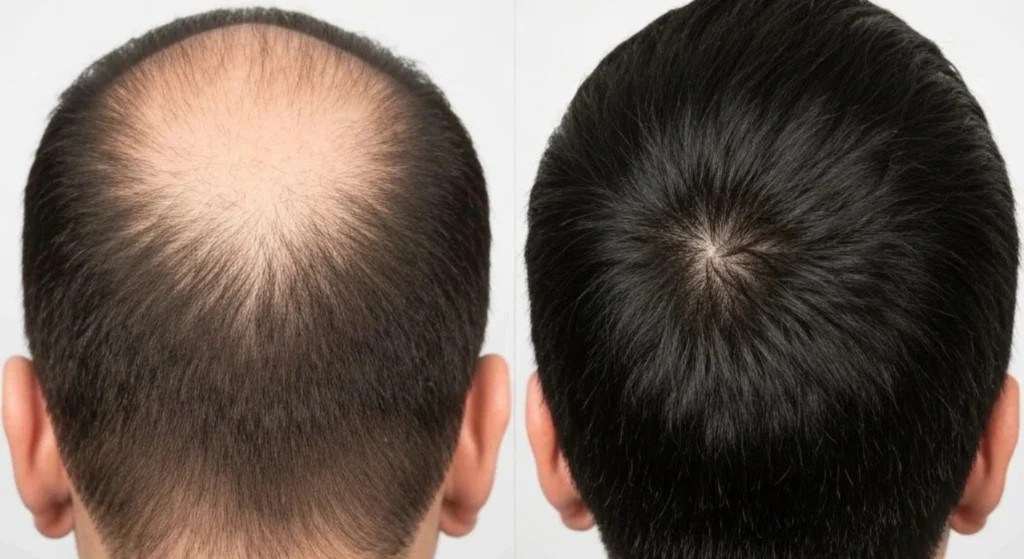
Crown baldness, medically termed vertex baldness, represents one of the most challenging and emotionally impactful forms of hair loss. The crown or vertex area sits at the top-back portion of your scalp, and hair loss in this region follows distinct patterns that require specialized treatment approaches for optimal restoration.
What Makes Crown Baldness Different?
Crown baldness differs significantly from frontal or temporal hair loss in several critical ways. The vertex area experiences unique challenges due to its circular growth pattern, varying hair angles, and the whorl formation that characterizes natural crown hair growth. Understanding these distinctions is essential for anyone considering crown area hair restoration at facilities like Vagus Hair Transplant in Islamabad.
The Science Behind Crown Hair Loss
Crown baldness typically results from androgenetic alopecia (male or female pattern baldness), where dihydrotestosterone (DHT) sensitivity causes progressive miniaturization of hair follicles. The vertex area contains a high concentration of androgen receptors, making it particularly vulnerable to DHT-related damage. This biological susceptibility explains why the crown often thins even when the frontal hairline remains intact.
Key Characteristics of Crown Baldness
Circular Pattern: Hair loss typically begins at the center and expands outward in a circular fashion
Progressive Nature: Gradual thinning over years, often unnoticed until significant density loss occurs
Whorl Disruption: Natural hair whorl pattern becomes increasingly visible and eventually disappears
DHT Sensitivity: High concentration of androgen receptors makes the area highly susceptible to hormonal hair loss
Age Correlation: Typically manifests between ages 25-50, though it can occur earlier with genetic predisposition
Norwood-Hamilton Classification for Crown Baldness
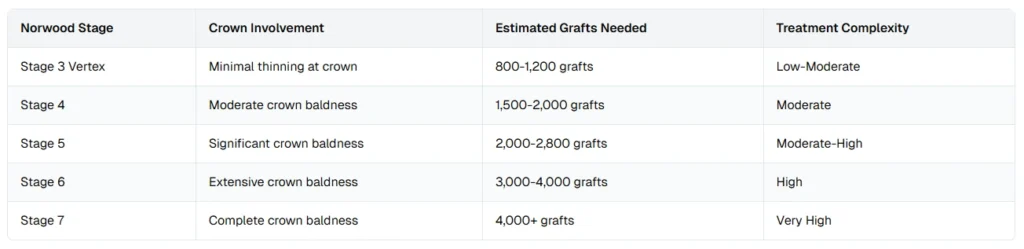
Medical professionals use the Norwood-Hamilton scale to classify male pattern baldness, with specific attention to vertex involvement. Understanding your classification helps determine the appropriate treatment strategy for crown hair transplant in Islamabad.
What is Crown Hair Transplant? Medical Definition & Overview
Crown hair transplant, also known as vertex area hair restoration, is a specialized surgical procedure designed to restore hair density and natural growth patterns to the top-back portion of the scalp. This procedure involves extracting healthy hair follicles from donor areas (typically the back and sides of the head) and meticulously transplanting them into the crown region to recreate natural hair distribution and the characteristic whorl pattern.
The Unique Challenges of Crown Restoration
Crown baldness hair transplant presents distinct technical challenges compared to frontal hairline restoration. The vertex area requires precise consideration of hair angle, direction, and the natural whorl pattern to achieve aesthetically pleasing and natural-looking results. At Vagus Hair Transplant in Islamabad, surgeons employ advanced techniques specifically adapted for crown restoration to address these complexities.
Why Crown Transplants Require Specialized Expertise
Complex Hair Growth Pattern
The crown features a natural whorl or spiral pattern where hair grows in multiple directions from a central point. Recreating this pattern requires surgical artistry and precise graft placement.
Variable Hair Angles
Unlike the frontal hairline with relatively uniform forward growth, crown hair exits the scalp at varying angles (typically 30-45 degrees) that change radially around the whorl center.
High Visibility Area
The crown is particularly visible from above and behind, making natural results critically important. Poor graft placement or unnatural patterns are immediately noticeable.
Graft Density Requirements
The crown typically requires higher graft density (40-50 follicular units per cm²) compared to other areas to achieve adequate coverage and natural appearance.
Am I a Candidate for Crown Hair Transplant? Evaluation Criteria
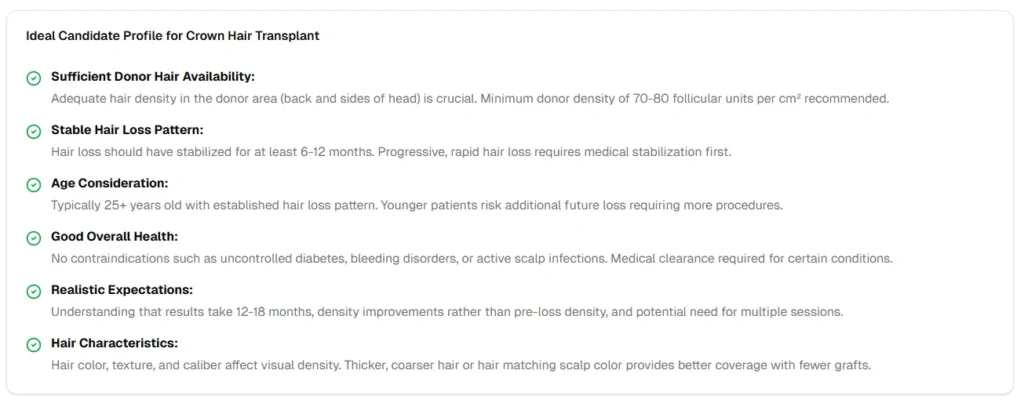
Determining candidacy for crown area hair restoration requires a comprehensive evaluation of several factors. Not all individuals experiencing crown baldness are suitable candidates for a hair transplant, and a thorough assessment is essential to ensure optimal outcomes and patient satisfaction. At Vagus Hair Transplant, our medical team conducts an in-depth evaluation to assess each patient’s unique needs, medical history, and hair restoration goals, enabling us to develop a personalized treatment plan to achieve the best possible results.
Essential Candidacy Requirements
Crown Hair Transplant Techniques: FUE vs FUT Methods
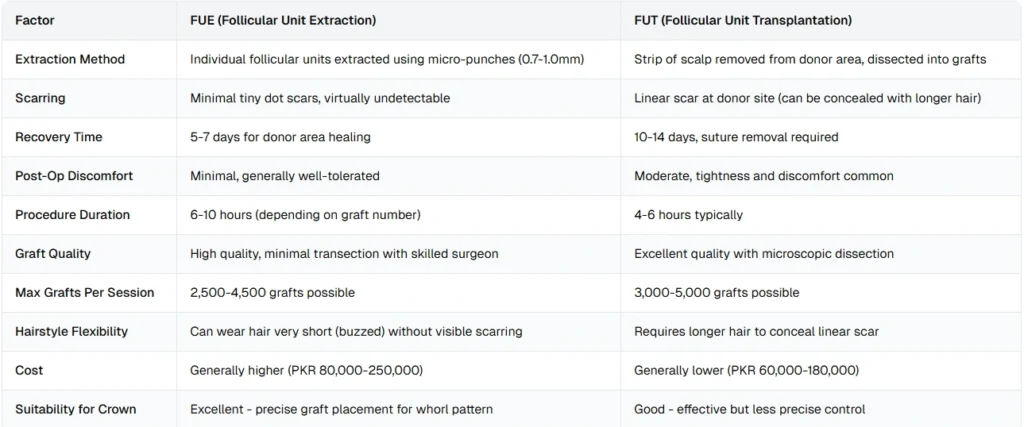
Two primary surgical techniques exist for crown hair transplant in Islamabad: Follicular Unit Extraction (FUE) and Follicular Unit Transplantation (FUT). Each method has distinct advantages, limitations, and suitability factors that influence technique selection for crown area hair restoration. Modern practices, including those at Vagus Hair, increasingly favor FUE for crown restoration due to its precision and aesthetic advantages.
The Unique Challenges of Crown Restoration
FUE Crown Hair Transplant: The Gold Standard for Vertex Restoration
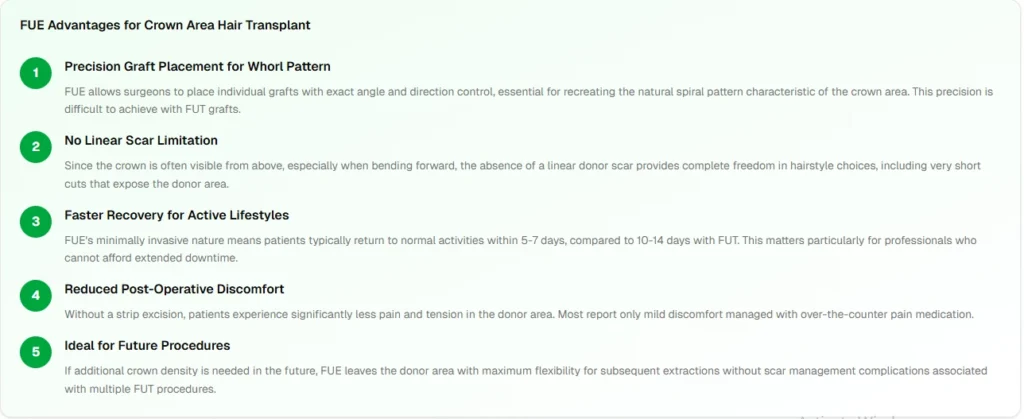
FUE (Follicular Unit Extraction) Vagus Hair Transplant in Islamabad has emerged as the preferred technique for crown baldness hair transplant due to its precision, minimal invasiveness, and superior aesthetic outcomes. For crown area hair restoration, FUE offers distinct advantages in creating natural whorl patterns and achieving optimal graft angulation. Advanced FUE techniques specifically adapted for complex crown restoration.
Why FUE Excels for Crown Restoration
Crown Hair Transplant Recovery: Complete Timeline & Care Guide
Crown hair transplant recovery follows a predictable timeline with specific milestones and care requirements at each stage. Understanding what to expect during crown hair transplant recovery helps patients prepare appropriately and optimize results. Vagus Hair Transplant provides comprehensive post-operative support throughout your recovery journey.
Factors Affecting Crown Transplant Outcomes
| Factor | Impact on Results | Optimal Condition |
|---|---|---|
| Donor Hair Density | Higher density enables more graft extraction, better coverage | 80+ FU/cm² in donor area |
| Hair Caliber (Thickness) | Thicker hair provides better visual density with fewer grafts | Medium to coarse texture |
| Hair-Scalp Color Contrast | Lower contrast creates illusion of higher density | Similar hair and scalp tones |
| Surgeon Experience | Critical for proper whorl pattern recreation and graft survival | 500+ crown procedures completed |
| Age at Procedure | Younger patients risk additional loss requiring more procedures | 30+ years with stable pattern |
| Post-Op Care Compliance | Proper care significantly impacts graft survival rates | 100% instruction adherence |
| Medical Support Therapy | Finasteride/minoxidil help maintain existing hair | Long-term medication compliance |
Cost of Crown Hair Transplant: Complete Price Breakdown in Islamabad
Understanding the cost of crown hair transplant in Islamabad helps patients plan financially and make informed decisions. Pricing varies based on multiple factors including graft number, technique used, clinic reputation, and surgeon expertise. Vagus Hair Transplant offers transparent pricing with detailed breakdowns to ensure patients understand exactly what they’re investing in.
| Baldness Level | Grafts Required | FUE Cost (PKR) | FUT Cost (PKR) |
|---|---|---|---|
| Minor Crown Thinning | 800-1,200 | 80,000-120,000 | 60,000-90,000 |
| Moderate Crown Baldness | 1,500-2,000 | 130,000-180,000 | 95,000-140,000 |
| Significant Crown Baldness | 2,000-2,800 | 185,000-250,000 | 145,000-200,000 |
| Extensive Crown Baldness | 3,000-4,000 | 260,000-350,000 | 210,000-280,000 |
| Complete Crown Restoration | 4,000+ grafts | 360,000-500,000+ | 290,000-400,000+ |
Risks & Complications: Understanding Crown Hair Transplant Safety
While crown hair transplant is generally safe with high success rates, understanding potential risks and complications enables informed decision-making and proper preparation. At Vagus Hair Transplant in Islamabad, comprehensive pre-operative screening and surgical expertise minimize these risks significantly. Transparency about possible complications is essential for patient education.
Typical Post-Procedure Effects – Not Complications
Temporary Swelling: Forehead and around eyes, typically days 2-4, resolves within week
Scabbing/Crusting: Normal healing response, forms within 24-48 hours, naturally sheds days 7-14
Shock Loss: Temporary shedding of transplanted hair weeks 2-4, regrowth begins month 3-4
Mild Pain/Discomfort: Manageable with over-the-counter medications, typically resolves within 3-5 days
Itching: Normal healing sign, begins around day 5-7, managed with prescribed sprays
Numbness: Temporary reduced sensation in crown area, typically resolves within 2-6 months
Potential Complications and Risk Factors
| Complication | Frequency | Prevention/Management |
|---|---|---|
| Infection | Rare (<1%) | Prophylactic antibiotics, sterile technique, proper wound care |
| Bleeding | Uncommon (2-3%) | Avoid blood thinners pre-op, careful hemostasis during procedure |
| Poor Graft Survival | Uncommon (5-10% of grafts) | Gentle graft handling, proper storage, experienced surgeon, good aftercare |
| Unnatural Appearance | Varies with surgeon skill | Experienced surgeon, proper whorl pattern recreation, appropriate density |
| Cyst Formation | Occasional (3-5%) | Usually resolves spontaneously, extraction if persistent |
| Persistent Numbness | Rare (<2%) | Careful surgical technique, usually resolves over 6-12 months |
| Scarring (Hypertrophic/Keloid) | Very Rare (<1% with FUE) | Pre-screening for keloid tendency, proper wound care, topical treatments |
Why Choose Vagus Hair Transplant for Crown Restoration in Islamabad?
Selecting the right clinic and surgeon for crown hair transplant significantly impacts your results and experience. Vagus Hair Transplant has established itself as a leading center for crown area hair restoration in Islamabad through consistent excellence, patient-centered care, and superior outcomes. Here’s what sets Vagus apart for crown baldness hair transplant.
Expert Surgical Team
• Board-certified hair restoration surgeons
• 25+ years combined experience
• 5000+ successful transplant procedures
• Specialized training in crown restoration
• International fellowship credentials
• Continuous education and technique updates
Advanced Technology
• Latest motorized FUE systems
• High-resolution digital microscopes
• Hypothermosol graft preservation
• PRP therapy enhancement options
• State-of-the-art surgical suites
• Digital planning and documentation
Patient-Centered Care
• Personalized treatment plans
• Transparent pricing with no hidden costs
• 24/7 post-procedure support hotline
• Comprehensive follow-up program
• Comfortable, private recovery rooms
• Multi-language consultation services
Success Rates & Real Results
95-98%
Graft Survival Rate
85%+
Hair Growth by Month 6
98%+
Patient Satisfaction
Ready to Take the Next Step?
Contact Vagus Hair Transplant today to schedule your free consultation for crown hair transplant in Islamabad. Our expert team is ready to answer your questions and guide you toward natural, permanent hair restoration.