Hair loss can be deeply distressing, especially when it appears suddenly or begins to alter your hairline. Many men searching for Telogen Effluvium or Male Pattern Baldness are not just looking for definitions; they want clarity, reassurance, and a practical way to determine what is actually happening to their hair. The core difference lies in pattern, cause, and long-term outcome. Telogen Effluvium is a temporary shedding condition triggered by stress, illness, hormonal shifts, or physiological shock, resulting in sudden diffuse thinning across the scalp. Male Pattern Baldness (Androgenetic Alopecia), however, is a genetically driven and progressive condition caused by DHT (Dihydrotestosterone), leading to hair follicle miniaturisation, thinning hair at the temples, crown thinning, and frontal hairline recession.
If you are asking, “Is my hair loss Telogen Effluvium or Male Pattern Baldness?” The answer depends on whether the shedding is sudden and evenly distributed or gradual and patterned. Telogen Effluvium is usually reversible once the underlying trigger is resolved, while Male Pattern Baldness is permanent without medical intervention. Understanding this distinction early is critical because misidentifying the condition can delay proper treatment and reduce the chances of preserving hair density.
Understanding Telogen Effluvium
Telogen Effluvium is a form of stress induced alopecia that disrupts the natural hair growth cycle. Normally, hair follicles rotate through the Anagen phase (active growth), Catagen phase (transition), and Telogen phase (resting and shedding). In this condition, a significant number of follicles prematurely shift into the Telogen phase, triggering excessive hair fall approximately two to three months after a physical or emotional stressor.
This explains why many men wonder, “Why am I suddenly losing so much hair?” The shedding often follows events such as high fever, surgery, post-illness hair loss, crash dieting, nutritional deficiencies, or severe psychological stress. Unlike genetic hair loss, the thinning appears evenly across the scalp rather than concentrating at the temples or crown. The increase in scalp visibility and sudden diffuse hair thinning can be alarming, but the follicles remain intact and capable of regrowth.
In most cases, Telogen Effluvium lasts between three and six months. Once the underlying cause is corrected, the hair regrowth timeline gradually resumes, and recovery from hair loss becomes visible within six to twelve months. Importantly, this condition is not typically permanent.
What Is Telogen Effluvium?
Telogen Effluvium is a temporary shedding condition that disrupts the normal hair growth cycle.
Understanding the Hair Growth Cycle
Hair grows in three phases:
| Anagen phase | Active growth phase |
| Catagen phase | Transitional phase |
| Telogen phase | Resting and shedding phase |
In Telogen Effluvium, a large number of hair follicles prematurely enter the Telogen phase, causing excessive hair fall 2–3 months after a triggering event.
Common Causes of Telogen Effluvium
Telogen Effluvium is commonly triggered by physiological or emotional stressors that disrupt the normal hair growth cycle. Post illness hair loss following high fever, infections, COVID-19, or major surgery is a frequent cause, as the body redirects energy toward recovery rather than hair production. Severe emotional stress, often referred to as stress induced alopecia, can also push a large number of follicles into the Telogen phase simultaneously. Additionally, crash dieting, nutritional deficiencies, hormonal imbalances, and major life trauma are well-recognised contributors to sudden diffuse hair thinning. Many men ask, “Why am I suddenly losing so much hair?” If the shedding began abruptly and appears evenly distributed across the scalp rather than forming a receding hairline, Telogen Effluvium is a likely explanation.
Telogen Effluvium Symptoms in Men
Telogen Effluvium symptoms in men typically present as diffuse thinning all over the scalp rather than a defined receding pattern. The condition is characterised by sudden hair shedding in men, often noticeable during washing or combing, along with a prolonged hair shedding phase that can last for several weeks or months. Many individuals also observe increased scalp visibility and excessive hair fall, particularly during routine grooming, which can make the overall hair density appear significantly reduced.
What Does Stress Hair Loss Look Like?
Stress hair loss vs genetic hair loss differs mainly in pattern. Stress-related loss appears evenly across the scalp, not concentrated at temples or crown.
Telogen Effluvium vs Male Pattern Baldness: The Core Differences
The most important distinction between Telogen Effluvium and Male Pattern Baldness lies in distribution and progression. Telogen Effluvium causes diffuse thinning all over the scalp, often with a positive hair-pull test and noticeable excessive hair fall during washing or combing. Male Pattern Baldness, in contrast, presents as diffuse thinning vs receding hairline, where hair loss is concentrated at the temples and crown.
Another difference between Telogen Effluvium and Androgenetic Alopecia is permanence. Telogen Effluvium represents temporary hair loss, while Male Pattern Baldness is permanent hair loss unless treated medically. The pattern also differs: sudden hair shedding in men suggests a temporary shedding condition, whereas a slow and progressive frontal hairline recession signals hormonal hair loss.
Additionally, What Causes Androgenetic Alopecia?
Some individuals ask whether Telogen Effluvium can turn into Male Pattern Baldness. It does not directly convert into it; however, it can reveal underlying genetic hair loss that was previously unnoticed.
How Long Does Telogen Effluvium Last in Men?
Typically:
- Shedding lasts 3–6 months
- The hair regrowth timeline begins once the trigger resolves
- Full recovery from hair loss may take 6–12 months
Is Telogen Effluvium Permanent?
No, in most cases it is not permanent. Hair follicles do not shrink permanently, unlike in Male Pattern Baldness.
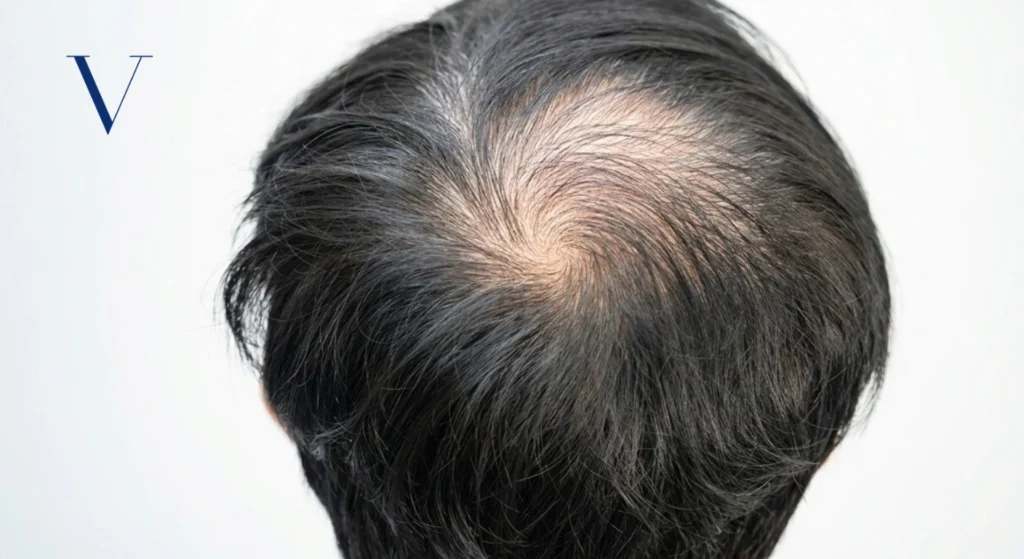
Signs of Early Male Pattern Baldness in 20s
The signs of early Male Pattern Baldness in the 20s often begin subtly but follow a recognisable progressive balding pattern. Many men first notice thinning hair at the temples, which gradually leads to frontal hairline recession and a more defined M-shaped hairline. Over time, crown thinning may also become apparent, reflecting the typical distribution seen in Androgenetic Alopecia. A strong family history of baldness further increases the likelihood that these changes are linked to a genetic predisposition to hair loss rather than a temporary shedding condition.
What Is Male Pattern Baldness (Androgenetic Alopecia)?
Male Pattern Baldness is a genetic predisposition to a hair loss condition driven by sensitivity to DHT (Dihydrotestosterone).
Related: How to Prevent Male Pattern Baldness?
DHT causes hair follicle miniaturisation, gradually shortening the Anagen phase and producing thinner, weaker strands.
Male Baldness Stages (Norwood Scale)
Doctors use the Norwood scale to classify stages of Male Pattern Baldness, from mild temple recession to extensive crown and frontal hair loss.
Does Stress Trigger Male Pattern Baldness?
Stress does not directly cause Androgenetic Alopecia. However, it can accelerate existing genetic hair loss. If you already have a genetic predisposition to hair loss patterns, stress may worsen it.
Telogen Effluvium vs Male Pattern Baldness: Key Differences
1. Diffuse Thinning vs Receding Hairline
| Feature | Telogen Effluvium | Male Pattern Baldness |
| Pattern | Diffuse thinning all over the scalp | Receding hairline & crown thinning |
| Onset | Sudden | Gradual |
| Cause | Stress, illness | Genetic + DHT |
| Permanent | Temporary hair loss | Permanent without treatment |
| Hair Pull Test | Often positive | Usually mild shedding |
Related, Does a Receding Hairline Mean Baldness?
2. Temporary Hair Loss vs Permanent Hair Loss
Telogen Effluvium = temporary shedding condition
Male Pattern Baldness = progressive follicle miniaturisation
3. Sudden Diffuse Hair Thinning vs Progressive Balding Pattern
If your hair loss happens rapidly after stress or illness, it’s likely Telogen Effluvium. If it’s slowly receding over the years, it’s probably Androgenetic Alopecia.
Can Telogen Effluvium Turn Into Male Pattern Baldness?
Telogen Effluvium does not directly turn into Male Pattern Baldness. However, it can unmask underlying genetic hair loss, making early Male Pattern Baldness more noticeable.
Diagnosis: How Doctors Determine the Hair Loss Type
If you are uncertain how to tell if hair loss is genetic, a Dermatologist diagnosis is the most reliable approach. Specialists evaluate scalp patterns, review medical history, and may perform a hair pull test. In some cases, blood tests are ordered to detect nutritional deficiencies or hormonal imbalances. Trichoscopy can help identify hair follicle miniaturisation, a hallmark of Androgenetic Alopecia.
The diagnostic process focuses on distinguishing sudden diffuse hair thinning from a progressive balding pattern. Early identification significantly improves treatment outcomes.
How to Reverse Telogen Effluvium Naturally
If diagnosed early, recovery from hair loss due to Telogen Effluvium is usually possible because it is a temporary shedding condition. The key is addressing the underlying trigger and restoring balance to the hair growth cycle.
Reducing stress is essential, especially in cases of stress induced alopecia, as chronic stress pushes more follicles into the Telogen phase. Improving sleep quality also supports hormonal balance and helps the body return to a healthy Anagen phase.
Correcting nutritional deficiencies such as iron, zinc, vitamin D, and protein can significantly improve hair density and reduce excessive hair fall. A balanced, protein-rich diet supports stronger regrowth, while a gentle hair care routine prevents additional strain on recovering follicles.
In most men, once the trigger is resolved, shedding slows, and the hair regrowth timeline gradually returns to normal within a few months.
Treatment and Recovery Outlook
For Telogen Effluvium, management centres on correcting the underlying trigger. Stress reduction, nutritional optimisation, improved sleep, and addressing deficiencies help restore the hair growth cycle. Because follicles are not permanently damaged, recovery from hair loss is generally achievable.
Male Pattern Baldness requires targeted treatment such as Minoxidil, Finasteride (a DHT blocker), PRP therapy, or surgical options in advanced male baldness stages. Early treatment prevents further hair follicle miniaturisation and slows crown thinning and frontal hairline recession.
Treatment for Male Pattern Baldness
Unlike Telogen Effluvium, Male Pattern Baldness typically requires medical intervention because it is a progressive and genetically driven condition. Evidence-based treatments such as Minoxidil help stimulate hair follicles and prolong the Anagen phase, while Finasteride works by reducing DHT (Dihydrotestosterone), the hormone responsible for hair follicle miniaturisation. In certain cases, PRP (Platelet-Rich Plasma) therapy may support hair density by enhancing follicular activity. For advanced stages of Androgenetic Alopecia, hair transplantation can provide a more permanent cosmetic solution. Early treatment is essential, as timely intervention significantly reduces further follicle miniaturisation and slows the progression of hair loss.
When Should You See a Dermatologist?
You should consider consulting a dermatologist if hair density loss continues beyond six months without improvement, as prolonged shedding may indicate underlying Male Pattern Baldness rather than temporary Telogen Effluvium. Medical evaluation is also important if a receding hairline becomes noticeable, crown thinning progressively worsens, or excessive hair fall does not reduce over time. Early dermatologist diagnosis helps distinguish between Telogen Effluvium or Male Pattern Baldness and prevents potential long-term follicle damage through timely and appropriate treatment.
Vagus Hair Transplant: A Doctor’s Perspective on Telogen Effluvium vs Male Pattern Baldness
Reputable hair restoration clinics in Islamabad focus on evidence-based techniques such as FUE and FUT for treating confirmed Male Pattern Baldness (Androgenetic Alopecia). In cases of Telogen Effluvium, which involves temporary diffuse shedding, qualified dermatologists generally do not recommend hair transplantation because the follicles are not permanently damaged. Therefore, before considering any surgical option, patients in Islamabad are advised to undergo a thorough dermatologist diagnosis to determine whether their condition is progressive genetic hair loss or a reversible shedding disorder. Proper evaluation ensures safe, appropriate, and result-oriented treatment decisions.
Final Thoughts: Act Before It’s Too Late
Understanding the difference between Telogen Effluvium and Male Pattern Baldness is critical for choosing the right treatment path. One is a temporary shedding condition triggered by stress, while the other is a genetically driven, progressive balding pattern.
If you’re experiencing sudden diffuse hair thinning, recovery is possible. If you notice thinning hair at temples or crown thinning, early intervention is key.
The earlier you identify whether it’s Telogen Effluvium vs Male Pattern Baldness, the better your chances of preserving your hair density and confidence.
Frequently Asked Questions
Is my hair loss Telogen Effluvium or Male Pattern Baldness?
If hair loss is sudden and diffuse, it’s likely Telogen Effluvium. If it follows a receding pattern, it’s likely Male Pattern Baldness.
Can Telogen Effluvium cause a receding hairline?
Typically no. It causes overall thinning, not frontal hairline recession.
How long does Telogen Effluvium last in men?
Usually 3–6 months of shedding with recovery within a year.
Does stress trigger Male Pattern Baldness?
Stress accelerates it but doesn’t cause it directly.
Is Telogen Effluvium permanent?
No, it’s usually reversible.
How to tell if hair loss is genetic?
Check for family history, temple recession, crown thinning, and progression matching the Norwood scale.