Yes, you can have both telogen effluvium and androgenetic alopecia at the same time. Telogen effluvium causes sudden, excessive hair shedding due to a disruption in the hair growth cycle. At the same time, androgenetic alopecia is a genetic condition driven by DHT that leads to gradual hair thinning through follicle miniaturization. When both occur together, telogen effluvium can temporarily worsen hair density, revealing underlying male or female pattern hair loss. The key difference is that telogen effluvium is usually reversible once the trigger resolves, whereas androgenetic alopecia is progressive and requires long-term management. Accurate diagnosis is essential because treatment approaches differ significantly.
Introduction
Understanding the difference between telogen effluvium and androgenetic alopecia is critical because they affect the hair growth cycle in very different ways. Telogen effluvium pushes a large number of hairs into the telogen phase, leading to sudden, excessive shedding. Androgenetic alopecia, in contrast, causes progressive hair miniaturization, leading to patterned hair loss such as a receding hairline, crown thinning, or widening part line.
When analyzing telogen effluvium vs androgenetic alopecia, many people struggle because both conditions can present with diffuse thinning and visible hair density loss. However, the causes, progression patterns, reversibility, and treatment strategies differ. This guide will clearly explain how to tell them apart, whether one can unmask the other, and what it means for long-term hair regrowth and management.
Understanding the Basics
What Is Telogen Effluvium?
Telogen effluvium is a form of temporary hair loss caused by a disruption in the hair growth cycle.
| Hair Growth Phase | Percentage of Scalp Hair | Function |
| Anagen Phase | 85–90% | Active growth phase where hair actively grows |
| Telogen Phase | 10–15% | Resting phase before natural shedding |
In TE, a trigger (stress, illness, surgery, low ferritin levels, hormonal shifts) pushes a large number of hairs into the telogen phase at once, leading to excessive hair shedding 2–3 months later.
Key Features of Telogen Effluvium
Telogen effluvium typically presents as sudden hair loss that begins a few months after a physical or emotional trigger. It causes diffuse hair thinning, meaning shedding occurs throughout the scalp rather than in a specific pattern. Unlike androgenetic alopecia, there is no significant hair miniaturization, and the hair follicles are not permanently damaged. Most importantly, telogen effluvium is often reversible once the underlying trigger, such as stress, illness, hormonal imbalance, or low ferritin levels, is addressed.
Is Telogen Effluvium Reversible?
Yes, in the majority of cases, telogen effluvium is temporary, and hair regrowth begins once the hair growth cycle stabilizes.
What Is Androgenetic Alopecia?
Androgenetic alopecia (AGA) is genetic hair loss, commonly known as:
- Male pattern baldness
- Female pattern hair loss
It is driven by DHT (dihydrotestosterone), which causes hair miniaturization, meaning each growth cycle produces thinner, shorter hair strands.
Key Features of Androgenetic Alopecia (AGA)
Androgenetic alopecia is characterized by gradual hair thinning rather than sudden shedding. In men, it typically presents as a receding hairline and crown thinning, while in women, it commonly appears as a widening part line with diffuse thinning over the crown. Unlike telogen effluvium, AGA involves progressive hair miniaturization, where follicles shrink over time, leading to long-term hair density loss. Without medical intervention, androgenetic alopecia is generally a progressive and permanent condition.
Does Androgenetic Alopecia Stop?
Androgenetic alopecia usually does not stop on its own. However, early treatment can slow progression and help maintain existing hair density.
Telogen Effluvium vs Androgenetic Alopecia: Core Differences
1. Hair Shedding vs Hair Thinning: What’s the Real Difference?
One of the most important distinctions in telogen effluvium vs androgenetic alopecia is the difference between hair shedding and hair thinning. Telogen effluvium primarily causes excessive hair shedding, with full-thickness strands falling out in large numbers due to disruption of the hair growth cycle. In contrast, androgenetic alopecia leads to gradual hair thinning caused by follicle miniaturization, meaning the hair becomes progressively finer and shorter over time rather than falling out all at once.
Additionally, How to Prevent Hair Thinning Naturally
2. Sudden Hair Loss vs Gradual Hair Loss Causes
When comparing telogen effluvium vs androgenetic alopecia, the timing and progression of hair loss provide important diagnostic clues. Telogen effluvium is associated with sudden hair loss, often triggered by stress, illness, surgery, hormonal imbalance, or low ferritin levels. It primarily affects hair quantity, leading to noticeable excessive shedding within a short period. In contrast, androgenetic alopecia develops as a gradual hair loss driven by genetic predisposition and DHT sensitivity. Rather than causing sudden shedding, AGA gradually impairs hair quality by miniaturizing follicles, resulting in progressively thinner, weaker strands over time.
Can androgenetic alopecia start suddenly?
Not typically, it progresses slowly, though TE can make it appear sudden.
3. Diffuse Thinning vs Receding Hairline
Another key distinction in telogen effluvium vs androgenetic alopecia is the pattern of hair loss. Telogen effluvium typically causes diffuse thinning across the entire scalp, resulting in a gradual reduction in hair density without a defined pattern. In contrast, androgenetic alopecia presents as a patterned form of hair loss. In men, this usually appears as a receding hairline combined with crown thinning, while in women it often manifests as a widening part line with central scalp thinning.
It is important to note that diffuse thinning is not always telogen effluvium. In its early stages, androgenetic alopecia can also appear diffuse, which is why proper clinical evaluation is necessary to differentiate between temporary shedding and progressive genetic hair loss.
4. Miniaturization vs Shedding Hair
A critical difference in telogen effluvium vs androgenetic alopecia lies in the mechanism of hair loss. Telogen effluvium leads to the shedding of full-thickness, healthy hair strands, as more follicles prematurely enter the telogen phase of the hair growth cycle. The follicles themselves remain structurally intact. In contrast, androgenetic alopecia is characterized by hair miniaturization, in which follicles gradually shrink under the influence of DHT, producing progressively thinner, shorter, and weaker strands over time.
Importantly, telogen effluvium does not cause hair miniaturization. Miniaturization is a hallmark feature of androgenetic alopecia and is a key diagnostic sign of genetic hair loss rather than temporary shedding.
Can Telogen Effluvium and Androgenetic Alopecia Occur Together?
Yes, this is where many people get confused.
Does Telogen Effluvium Unmask Androgenetic Alopecia?
Yes, telogen effluvium can unmask underlying androgenetic alopecia. If a person already has mild or undetectable genetic hair loss, a sudden episode of telogen effluvium can trigger excessive shedding and significantly reduce overall hair density. This temporary loss of volume may make pre-existing patterned hair loss, such as a receding hairline, crown thinning, or widening part line, more visible.
As a result, many individuals begin to wonder, “Can telogen effluvium reveal hidden male pattern baldness?” The answer is yes; telogen effluvium does not cause genetic hair loss, but it can expose it by accelerating visible thinning in susceptible individuals.
Can Telogen Effluvium Turn Into Androgenetic Alopecia?
No, telogen effluvium does not transform into androgenetic alopecia. Telogen effluvium is a temporary shedding disorder caused by a disruption in the hair growth cycle, whereas androgenetic alopecia is a genetically driven condition characterized by progressive hair miniaturization. However, telogen effluvium can expose pre-existing androgenetic alopecia that was previously mild or unnoticed. In individuals who are genetically predisposed to patterned hair loss, a sudden episode of excessive shedding may accelerate visible thinning and make receding areas more apparent. Therefore, while telogen effluvium does not turn into androgenetic alopecia, it can reveal or highlight underlying genetic hair loss.
How Long Does Telogen Effluvium Last vs Androgenetic Alopecia?
When comparing telogen effluvium vs androgenetic alopecia, the duration of hair loss is one of the most important distinguishing factors. Telogen effluvium is typically temporary and lasts around 3–6 months in acute cases, with hair regrowth beginning once the underlying trigger, such as stress, illness, hormonal imbalance, or low ferritin levels, is resolved. In some individuals, chronic telogen effluvium may persist longer but still does not involve permanent follicle damage.
If excessive shedding continues beyond 6–9 months, especially when accompanied by visible thinning or signs of hair miniaturization, it is advisable to consult a dermatologist to rule out underlying androgenetic alopecia or other causes of persistent hair density loss.
Telogen Effluvium Regrowth vs AGA Regrowth
| Telogen Effluvium Regrowth Signs | AGA Progression Signs |
| Baby hairs growing evenly | Continued miniaturization |
| Reduced shedding | Thinner regrowth |
| Improved density over months | Receding hairline progression |
| Crown thinning worsening |
How Dermatologists Diagnose Telogen Effluvium vs AGA
When evaluating telogen effluvium vs androgenetic alopecia, dermatologists begin with a detailed clinical examination of the scalp and hair pattern. They assess whether the hair loss is diffuse or patterned, looking for signs such as a receding hairline, crown thinning, or widening part line that may indicate androgenetic alopecia. A key diagnostic clue is the presence of miniaturized hairs, which are characteristic of AGA but not telogen effluvium.
Physicians may also perform a hair pull test, gently tugging small sections of hair to determine whether excessive shedding is occurring, which is more suggestive of telogen effluvium. These clinical findings help differentiate temporary shedding from progressive genetic hair loss.
Dermoscopy Findings: Telogen Effluvium vs Androgenetic Alopecia
Dermoscopy is an important tool in differentiating telogen effluvium from androgenetic alopecia. In telogen effluvium, the hair shafts typically show a uniform diameter, meaning there is no significant variation in thickness because the follicles are not undergoing miniaturization. In contrast, androgenetic alopecia is characterized by noticeable variation in hair shaft thickness, a key sign of hair miniaturization. This diversity in strand diameter, where some hairs appear significantly thinner than others, is a hallmark feature of genetic hair loss and helps dermatologists confirm AGA.
Biopsy Findings: Telogen Effluvium vs Androgenetic Alopecia
In complex cases where the diagnosis remains unclear, a scalp biopsy may be performed to distinguish telogen effluvium from androgenetic alopecia. In telogen effluvium, biopsy findings typically reveal an increased proportion of hairs in the telogen phase, reflecting excessive shedding without structural follicle damage. The overall follicle size remains normal.
In contrast, androgenetic alopecia shows miniaturized hair follicles along with an altered anagen-to-telogen ratio. The presence of smaller, thinner follicles confirms progressive hair miniaturization, which is a defining feature of genetic hair loss rather than temporary shedding.
Blood Tests and Hormonal Factors
Blood tests can play an important role in differentiating telogen effluvium vs androgenetic alopecia, particularly when nutritional or hormonal triggers are suspected. Low ferritin levels, which indicate reduced iron stores, are commonly associated with telogen effluvium and can disrupt the hair growth cycle, pushing more hairs into the telogen phase and causing excessive shedding. Correcting iron deficiency often improves temporary hair loss.
Another important distinction involves DHT (dihydrotestosterone). Telogen effluvium is not DHT-driven and does not involve hormone-induced follicle miniaturization. In contrast, androgenetic alopecia is highly DHT-sensitive, meaning this hormone progressively shrinks hair follicles, leading to patterned hair loss and long-term thinning.
Is Telogen Effluvium Reversible, but Androgenetic Alopecia Permanent?
In most cases, telogen effluvium is a form of temporary hair loss, whereas androgenetic alopecia is a progressive, long-term condition. Telogen effluvium occurs due to a temporary disruption in the hair growth cycle. Once the underlying trigger, such as stress, illness, hormonal imbalance, or low ferritin levels, is addressed, normal hair growth typically resumes.
Normal Shedding vs Early Balding Difference
| Normal shedding | Early balding |
| 50–100 hairs daily | Visible scalp |
| No visible density loss | Patterned thinning |
| Hair miniaturization signs |
Can Stress Cause Permanent Baldness?
Stress causes telogen effluvium (temporary).
It does not directly cause genetic hair loss, but it can worsen or reveal it.
Telogen Effluvium vs Male Pattern Baldness
When comparing telogen effluvium vs male pattern baldness, the pattern of hair loss is the key difference. Telogen effluvium causes diffuse shedding across the entire scalp, without a defined pattern. In contrast, male pattern baldness (androgenetic alopecia in men) presents with a receding hairline and crown thinning, gradually forming a characteristic patterned hair loss over time.
Related, Telogen Effluvium or Male Pattern Baldness? How to Tell the Difference Before It’s Too Late
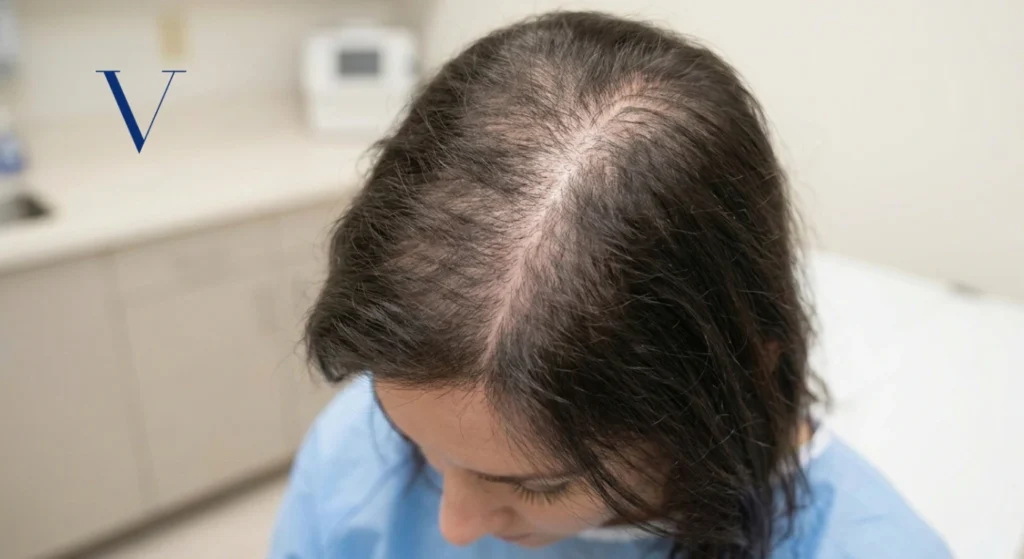
Telogen Effluvium vs Female Pattern Hair Loss
In women, the distinction between telogen effluvium and female pattern hair loss lies in the distribution of hair loss. Telogen effluvium typically causes even, diffuse thinning across the scalp due to excessive shedding. Female pattern hair loss, however, commonly appears as a widening part line with central scalp thinning, reflecting progressive genetic hair loss rather than temporary shedding.
Vagus Hair Transplant for Androgenetic Alopecia (Not Telogen Effluvium)
When discussing telogen effluvium vs androgenetic alopecia, it’s important to understand that hair transplant procedures such as Vagus Hair Transplant are only suitable for androgenetic alopecia, not telogen effluvium. Since telogen effluvium is a temporary shedding condition and does not involve permanent follicle miniaturization, surgical restoration is not recommended for TE.
However, in cases of genetic hair loss, including male pattern baldness and female pattern hair loss, advanced techniques like Vagus Hair Transplant can help restore density in areas affected by hair miniaturization, receding hairline, crown thinning, or widening part line. If telogen effluvium has unmasked underlying AGA, a hair transplant may be considered only after the shedding phase stabilizes and a dermatologist confirms patterned hair loss.
Before opting for any surgical solution, it is crucial to distinguish between excessive hair shedding and permanent hair thinning, as performing a transplant during active telogen effluvium may not address the root cause of hair density loss.
Final Thoughts: Telogen Effluvium vs Androgenetic Alopecia
When comparing telogen effluvium vs androgenetic alopecia, the key distinction lies in shedding vs miniaturization, temporary vs progressive, and trigger-based vs genetic hair loss.
If you’re experiencing excessive hair shedding along with patterned thinning, you may be dealing with both conditions.
The most important step?
Early diagnosis.
While telogen effluvium is reversible, androgenetic alopecia requires proactive management to preserve hair density in the long term.
Frequently Asked Questions
Can you have both TE and AGA?
Yes. TE can occur on top of underlying androgenetic alopecia.
Is my hair loss telogen effluvium or androgenetic alopecia?
Sudden excessive shedding suggests TE. Gradual thinning with miniaturization suggests AGA.
Is diffuse thinning always telogen effluvium?
No. Early AGA can also be diffuse.
How to tell if hair loss is temporary?
Look for shedding pattern, triggers, and regrowth signs within 6 months.